From intelligent perception to unmanned rescue: emergency equipment in the new era safeguards the safety of millions of households - 2026 Disaster Prevention and Mitigation Safety Emergency Expo showcases enterprises' new productive forces
With the frequent occurrence of extreme disasters and the continuous emergence of complex rescue scenarios, how can emergency equipment achieve comprehensive innovation and breakthroughs in the new era? When AI algorithms, Beidou positioning, and multi-sensor fusion technology are deeply integrated, what intelligent leaps have emergency rescue witnessed? How can rescue drones overcome the limitations of complex terrain to achieve precise material delivery and real-time monitoring? These technological innovations are significantly enhancing the autonomous decision-making and collaborative operation capabilities of emergency equipment, laying a solid technological foundation for disaster prevention and mitigation.
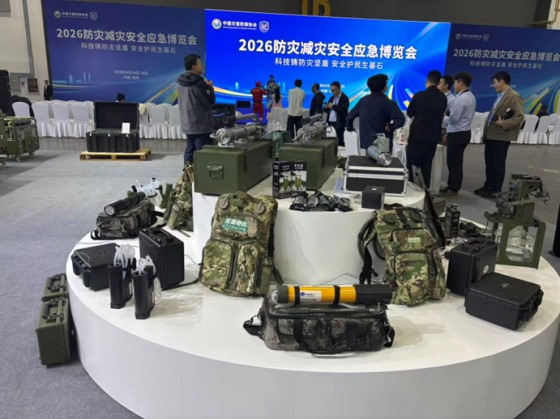
On April 16th, the 2026 Disaster Prevention and Mitigation Safety and Emergency Expo opened at the Hangzhou International Expo Center.
Themed "Technology Builds a Strong Shield for Disaster Prevention, Safety Protects the Foundation of People's Livelihood", the conference gathered top domestic enterprises and research institutions in the emergency response field to showcase new-generation emergency safety technology achievements such as artificial intelligence, unmanned equipment, low-carbon practical applications, and lightweight protection. Representatives from enterprises in the fields of construction machinery, fire rescue, railway disaster prevention, environmental safety, ocean monitoring, and embodied intelligence shared cutting-edge concepts and core equipment, jointly promoting the comprehensive upgrading of China's disaster prevention and mitigation towards intelligence, unmanned operations, localization, and practical applications.
Precision perception and intelligent decision-making reshape the new paradigm of disaster prevention and mitigation
Artificial intelligence (AI) is emerging as the core driving force for disaster prevention and mitigation in the new era. From risk monitoring and intelligent identification to precise manipulation, AI technology is comprehensively enhancing the precision and efficiency of emergency response, facilitating a shift from "passive response" to "active early warning". In the field of disaster prevention for transportation infrastructure, the deep integration of AI and drone technology is addressing many pain points associated with traditional inspection methods.
Researcher Wang Zihong from the Railway Construction Research Institute of China Academy of Railway Sciences introduced that the institute demonstrated its independently developed intelligent disaster prevention technology for railway tunnels at this conference. This technology is based on self-developed intelligent monitoring modules for electromechanical equipment such as tunnel protective doors, jet fans, emergency lighting, and a tunnel electromechanical fire fighting equipment monitoring system and emergency command platform, achieving comprehensive monitoring of 27 parameters including electromechanical, fire fighting, and personnel. The automatic inspection efficiency has been improved by 80%, and the emergency response time has been shortened by 4/5, realizing intelligent command of "multi-disaster assessment - cross-platform linkage - dynamic decision-making" for the first time. It has been successfully applied in the design, equipment integration, and implementation projects of compliance research and evaluation for disaster prevention and evacuation rescue equipment and facilities in more than 400 existing tunnels of Guangzhou, Xi'an, Wuhan, Lanzhou, and Beijing Railway Bureaus. At the same time, the Railway Construction Research Institute has also proposed intelligent inspection technology for railway drones in disaster prevention and control technology for high-altitude giant landslides and rockfalls on railway and highway, and has built a multi-dimensional, multi-field, multi-process large-scale landslide model test platform, providing solid technical support for the safety of railway transportation infrastructure.
In addition to intelligent monitoring in macro scenarios, AI technology also demonstrates strong potential in the field of micro-precise operations. The intelligent product line of water quality online monitoring instruments from Yimu Technology was also unveiled. The products focus on scenarios such as municipal water production and supply, and pipe network monitoring, achieving precise perception and intelligent transmission throughout the entire process. Through actual testing, the data consistency between domestically produced instruments and imported equipment exceeded 99%, with key indicators comparable to international standards. They combine the advantages of autonomy, controllability, convenient operation and maintenance, and a digital ecosystem, using hardcore domestic capabilities to assist in the digital upgrade of water affairs.
In addition to water-related products, Yimu Technology also showcased its visual and tactile sensor products in the field of embodied intelligence.
The mechanical gripper equipped with a self-developed visual-tactile sensor from Yimu Technology can smoothly pick up a fragile potato chip without causing any damage, demonstrating ultimate flexible manipulation capabilities. According to Huang Pirun from the Yimu Technology Intelligent Ecological Solutions Research Institute, the visual-tactile sensor captures subtle deformations when elastic materials come into contact with objects through a built-in camera, converts physical contact signals into computable digital image data, and then analyzes rich tactile information through AI algorithms. The sensor boasts multiple high-tech specifications, including micron-level deformation calculation accuracy, a force resolution of 0.005N, and an output frame rate of up to 120fps, providing real-time and reliable tactile feedback for robotic precision operations and offering critical tactile perception capabilities for the application of embodied intelligence in emergency scenarios.
Achieve autonomous and controllable coverage of extreme scenarios across air, space, land, and sea
If AI technology is the "smart brain" for disaster prevention and mitigation, then unmanned equipment is the "tough hands and feet" that penetrate deep into the front line. A large number of high-end equipment that can operate in complex environments such as mountains, underwater, plateaus, and ruins were showcased, marking a new stage for China's emergency rescue equipment to enter the era of unmanned, domestically produced, and autonomous controllable equipment.
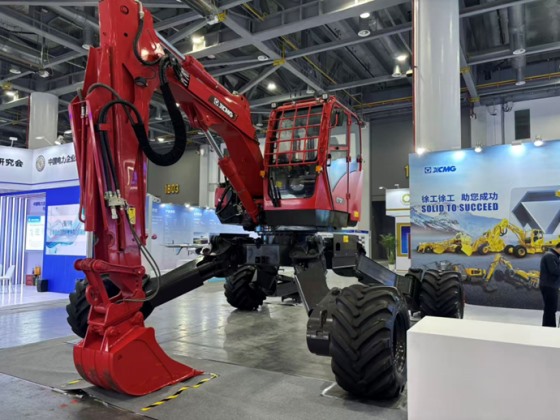
XCMG booth
Ge Heng'an, General Manager of the Marketing Company of the High-Tech Equipment Branch of XCMG Construction Machinery Co., Ltd., introduced that XCMG's key exhibits this time include the ET121 "Steel Mantis" walking excavator and the XUV25 air-ground integrated unmanned transport platform, which are mainly targeted at extreme scenarios such as forest firefighting, geological disasters, plateau construction, and emergency rescue in complex terrains. They achieve comprehensive autonomy and controllability. From early absorption of foreign technology to today's complete independent transformation and upgrading, core components such as oil cylinders and hydraulic parts are 100% domestically produced, and control programs and core chips are all independently developed by XCMG, completely eliminating dependence on foreign countries. Ge Heng'an stated that emergency equipment has extremely high safety requirements for core components, and it is necessary to avoid being "choked" during wartime or emergency rescue. Therefore, achieving full-chain autonomy and safety in both software and hardware is essential to ensure stability and reliability in extreme scenarios. In addition to the ET121 model, XCMG's ET100D modular walking excavator, the world's largest tonnage ET210 walking excavator, and other similar series models have all achieved full domestic production of core components, suitable for various complex rescue and national defense construction tasks.
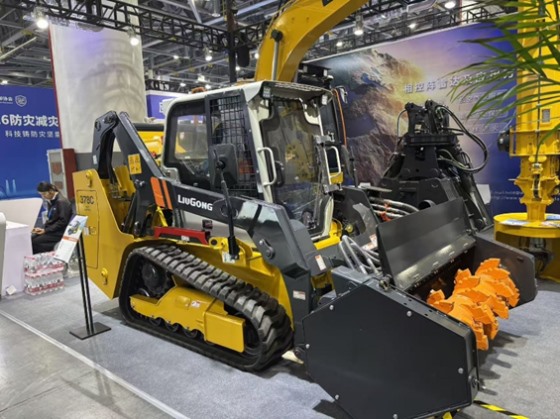
Liugong booth
In addition to rescue equipment for complex land terrains, underwater emergency response equipment has also become a focus of attention at the conference. Xu Dehuai, Product Manager of Liugong, introduced that Liugong exhibited specialized equipment for forest fire fighting and intelligent underwater salvage equipment. The underwater salvage equipment is equipped with a synchronous 3D observation system, allowing real-time sharing of vision between the front-end observation equipment and a 22-ton large excavator. With precise observation on one side and efficient salvage and grabbing on the other, the maximum operating depth reaches 21.2 meters, mainly used for high-risk tasks such as underwater hazardous material removal. Xu Dehuai stated that equipment enterprises must deeply participate in the construction of the emergency response field in the long term. Currently, emergency procurement often adopts a comprehensive contracting model, where one bid section includes hundreds of types of equipment. The products of a single enterprise are limited, making it difficult to meet the full set of needs. The industry generally faces issues such as insufficient integration between products and scenarios, and weak adaptability. In the future, there is an urgent need to strengthen resource integration and enhance the systematization and scenario-specific capabilities of equipment.
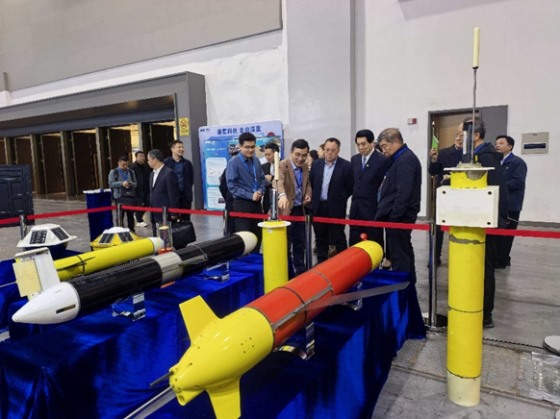
Weihai Mingxiang Technology Co., Ltd. Booth
The application boundaries of unmanned equipment are constantly expanding, extending from land and underwater to the ocean. Pang Ling from Weihai Mingxiang Technology Co., Ltd. introduced that the company exhibited a series of products including long-range, low-power underwater gliders, automatic profiling buoys, and multi-parameter drifting buoys. These products operate at depths ranging from 0 to 2000 meters and can be equipped with various marine sensors such as temperature, salinity, depth, pH, dissolved oxygen, and chlorophyll. They are widely used in deep-sea observation, polar scientific research, marine environmental monitoring, and other fields, providing continuous, stable, and wide-ranging ocean observation and data support for marine disaster prevention and mitigation, filling the gap in emergency observation equipment for the deep and open seas.
Drones also shone brightly in the field of fire rescue.
China Construction Sixth Engineering Division Corporation showcased its full-industry chain building emergency support system. The company's Scorpio I and Cobra I fire-fighting robots can enter confined spaces to exhaust smoke and extinguish fires. The positioning helmet can achieve real-time monitoring and one-click alarm for construction personnel through 4G+Beidou technology. The company also demonstrated the B100P lifting and rescue drone, which has a maximum load capacity of 50kg and can transport up to 16 kilometers away. It can accurately deliver supplies in complex scenarios such as mountains and floods, establishing an aerial emergency access.
Prioritize prevention, pursue green and efficient development, and firmly establish the safety bottom line
Whether it's the precise empowerment of AI technology or the tough tackling of unmanned equipment, ultimately, it all comes back to the core demand of "practical application in actual combat". Focusing on the development direction of actual combat, low-carbonization, and lightweight, a batch of emergency equipment that is close to disaster types, close to the front line, and close to support was unveiled at the conference, promoting the transformation of the emergency system from "mainly fire fighting" to "combination of prevention and suppression, fine prevention and control, and green support".
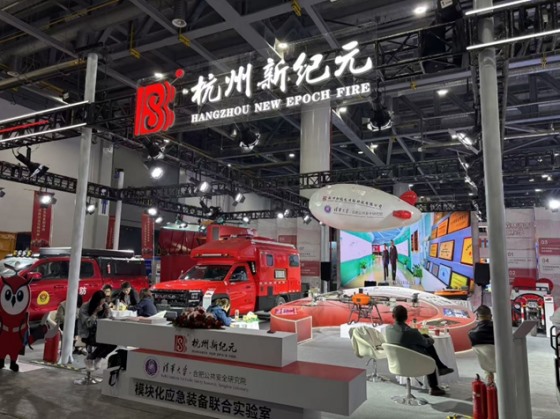
Booth of Hangzhou New Era Fire Technology Co., Ltd
In the field of forest firefighting, both conceptual innovation and equipment upgrading are being advanced simultaneously. Hangzhou New Era Fire Technology Co., Ltd. exhibited emergency support vehicles, emergency airships, mobile compressed air foam stations, booster fire-fighting modules, heavy-duty drones, drone shelters, hand-lifted pumps, backpack water pumps, and water rescue equipment. The company's personnel told reporters that they have currently proposed the concept of "forest firefighting engineering". Currently, the company is collaborating with the Fire Rescue Academy to compile a book titled "Forest Firefighting Engineering". The core idea is to implement a sustainable management closed loop that emphasizes one plan and one scheme for each mountain, adheres to prevention as the primary focus, integrates prevention and suppression, combines dredging and blocking, and facilitates recycling. This will contribute to the scientific, refined, and systematic development of forest firefighting.
Zhejiang Chimey Environmental Technology Co., Ltd.Full-Scenario Emergency Water Treatment Technology Matrix
In the most fundamental field of emergency water supply for people's livelihood security, low-carbon and modular technologies are building a full-scenario security network. Xing Junwei from Zhejiang Chimey Environmental Technology Co., Ltd. introduced to reporters the full-scenario emergency water treatment technology matrix, covering the entire chain of needs from individual portable solutions to large-scale water supply. Large-scale equipment includes the CM-FCYJ shelter-type emergency water treatment system, which integrates full-process purification and can meet the drinking water security needs of tens of thousands of people with a single set, and is designed for rapid deployment on vehicles; the CM-JZX-FST containerized modular seawater desalination system is suitable for emergency water supply in coastal areas and islands; and the CM-CZYJ vehicle-mounted mobile water treatment system can flexibly adapt to various water sources. In addition, the company also showcased portable products including portable water purification devices, field water purification tanks, individual ultrafiltration straws, manual reverse osmosis water purifiers, etc., which can treat surface water, brackish water, seawater, etc., and can respond to various disasters such as floods, earthquakes, and environmental pollution. With low-carbon, efficient, and modular technologies, it builds an all-weather emergency water supply security system to comprehensively safeguard people's livelihood security.
This emergency equipment exhibition also comprehensively showcases the robust capabilities of technology-enabled emergency rescue. The China North Industries Group Corporation exhibited a mobile power supply platform centered around aviation-grade gas turbine technology. The gas turbine power supply vehicle possesses advantages such as rapid start-up, low noise, and low emissions, with power output ranging from 2MW to 30MW. It can adapt to extreme environments such as severe cold in the north and hypoxia on high altitudes, meeting the needs of major engineering construction, urban emergency power supply, field operations, border defense and control, and achieving "instant stop and supply, stable operation". The supporting emergency backup power system, centered around intelligent monitoring, automatic switching, and long-duration energy storage, covers fixed scenarios such as data centers and hospitals, establishing a dual energy guarantee of "mobile + static" to build a seamless defense line for emergency power supply.
At this exhibition, from large-scale rescue equipment to individual support equipment, from AI intelligent perception to unmanned collaborative operations, and from conceptual innovation to technological breakthroughs, the current exposition fully demonstrates the independent innovation capability, full-chain supporting capability, and practical application capability of China's emergency equipment industry. By empowering disaster prevention and mitigation with technology and building a safety defense line with a systematic approach, China will continue to promote the in-depth application of new productive forces in the emergency response field, accelerate the construction of a higher-level resilience and safety system, and provide a more solid and reliable guarantee for people's lives and property safety.
Source: China Industry News Network 2026-04-17 07:25
Guo Yu, reporter of China Industry News
Editor: Ma Yan
